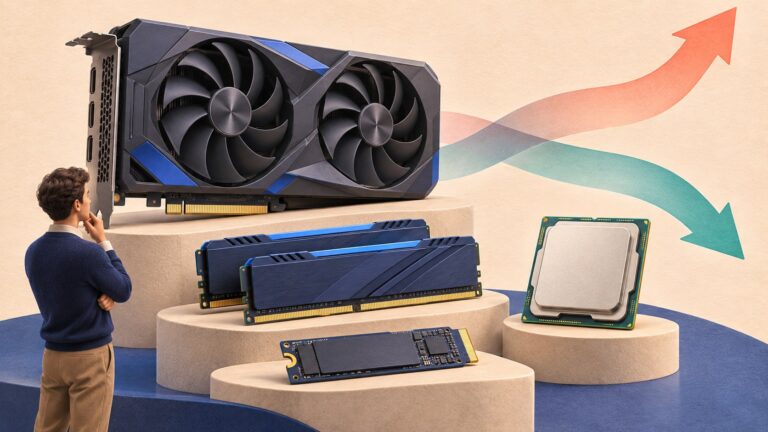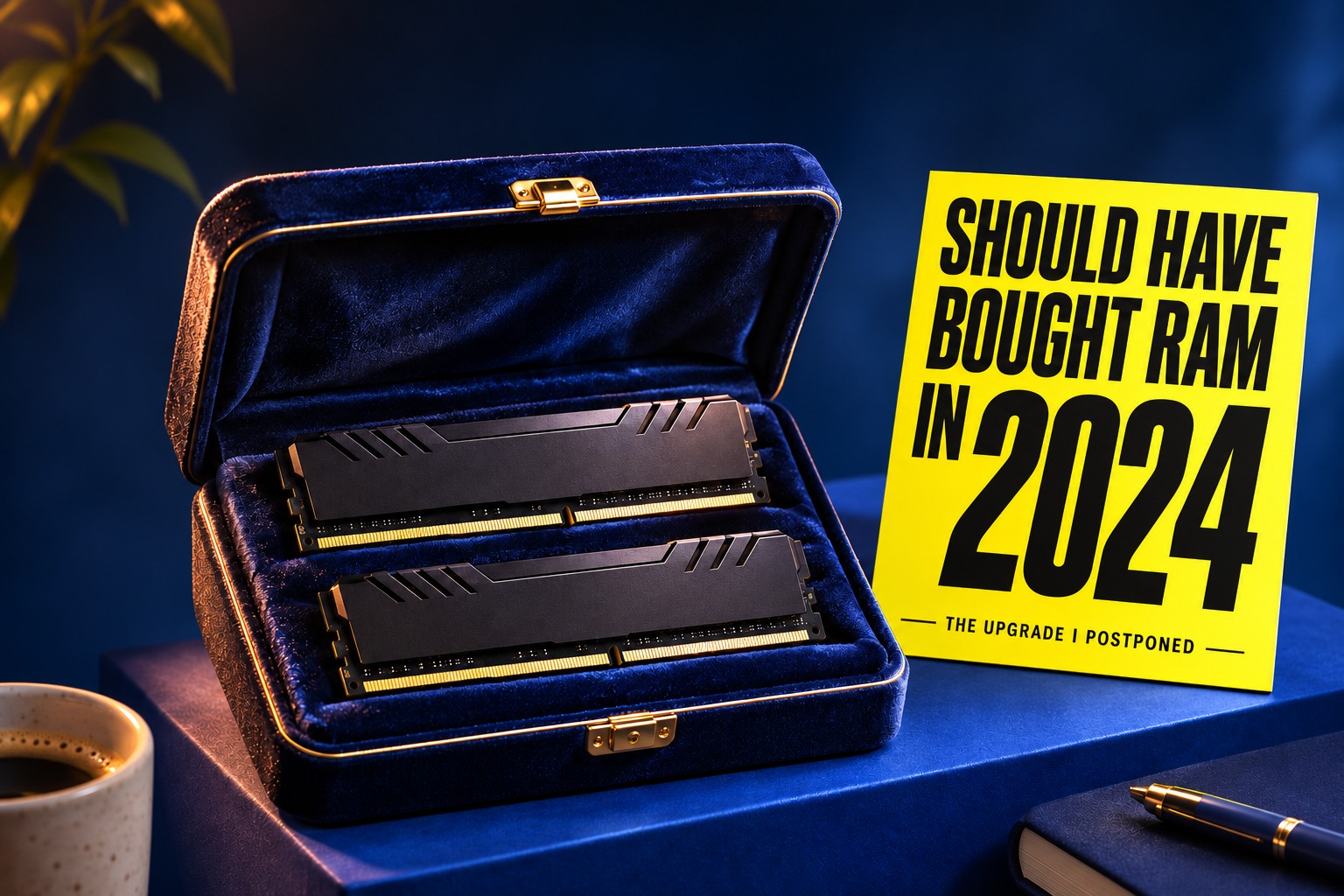
There are purchases you regret making. Then there is the RAM upgrade you regret leaving in a shopping cart for two years.
In 2024, the plan sounded responsible: “I will buy it when it gets cheaper.” In 2026, the same sentence feels like something a villain says immediately before the laboratory explodes.
Calling it the biggest regret of the century is obviously PC-builder comedy. The pressure behind RAM prices in 2026, however, deserves a serious explanation. AI infrastructure is competing for memory manufacturing resources, suppliers are changing their product mix, and an older memory generation does not automatically become a bargain.
The joke is about hindsight. The useful question is what to do with the computer, budget, and workload you actually have today.
Market context checked on November 10, 2026. Original editorial illustrations are conceptual scenes, not photographs of retail offers.
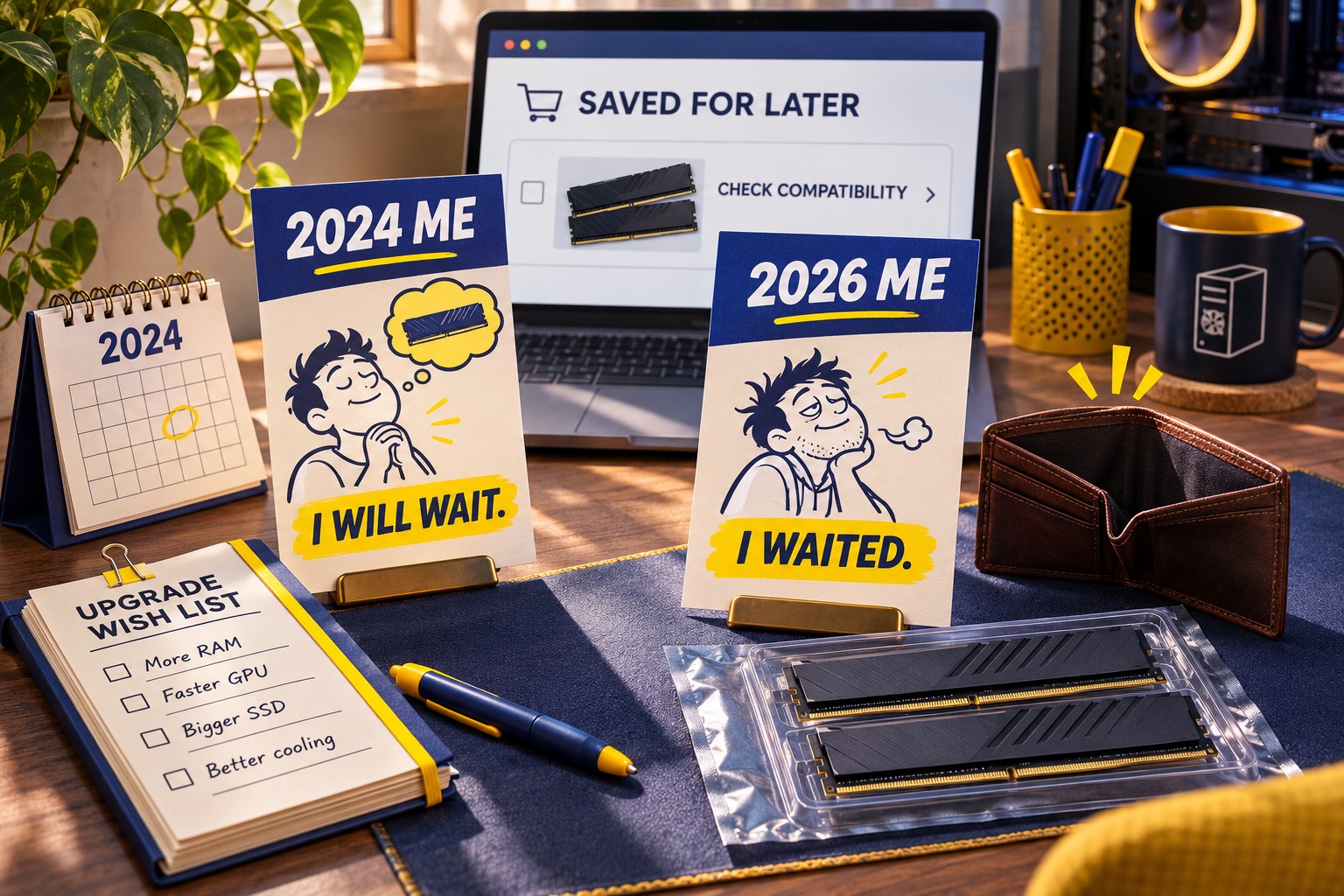
Dear 2024 me: that shopping cart was not a savings account
You remember the routine. Open a memory-kit listing. Read three reviews. Compare the heat spreader with another heat spreader. Decide that the truly mature choice is to wait for a slightly better discount.
Then spend the evening considering a keyboard with the acoustic properties of artisanal popcorn.
The RAM stays in the cart. The cart becomes a wishlist. The wishlist becomes an archaeological site.
That is why the 2024 joke lands: the upgrade felt ordinary and postponable. A memory kit was supposed to be a practical component, not something you imagined in a velvet presentation box.
Still, 2024 was not one universally cheap moment. On November 18, 2024, TrendForce described downward pressure on mature DRAM products, including DDR4, and revised its outlook toward weaker prices in 2025. Waiting could therefore look reasonable using information available at the time.
Your past self did not have a secret semiconductor dashboard. They had a browser, a budget, and the confidence of someone who had not yet met 2026.
Why RAM prices became a serious problem
RAM is working memory: it holds information that active applications need to access quickly. A useful memory upgrade can create room for larger projects or more simultaneous work when capacity is the actual limitation.
The chips inside a desktop memory kit also belong to a much larger industrial system. Production choices respond to demand from servers, mobile devices, PCs, and other equipment. Your two-stick upgrade is only one small request in that queue.
AI demand has a much bigger shopping cart
AI infrastructure needs substantial amounts of memory. High-bandwidth memory, or HBM, serves demanding accelerator workloads, while servers also use other forms of DRAM. Those are distinct products from the desktop DIMMs you install at home.
The connection is upstream: manufacturing resources, investment, process capacity, and product priorities. A supplier can devote more of its constrained resources to high-value server products while PC buyers compete for the supply available to them.
TrendForce's September 30, 2026 outlook described suppliers continuing to prioritize advanced-process capacity for high-performance server products. It also warned that PC DRAM supply could decline in 2027 as more capacity shifts toward servers.
That does not mean someone is physically taking your gaming RAM and plugging it into an AI accelerator. It means the factory-level decisions behind both markets can affect what reaches your local store.
Your shopping cart says “one kit.” A data center's shopping cart has a procurement department.

DDR4 did not receive a permanent cheapness certificate
“Fine, I will buy the older generation” sounds like an excellent escape route. Sometimes it is. Sometimes the escape route also has a queue.
In its June 5, 2025 DDR4 report, TrendForce linked stronger price pressure to major suppliers reducing DDR4 production and buyers bringing purchases forward. Its discussion of end-of-life plans also distinguished customer segments; continued consumer demand meant the story was more complicated than every DDR4 factory simply closing overnight.
The practical lesson is straightforward: aging technology can become less available while plenty of existing systems still need it. “Older” describes a generation. It does not guarantee a discount.
Think of the replacement part for an old appliance. The appliance may be old; the replacement part can still have expensive opinions.
How big were the reported increases?
The numbers below show why the conversation became so dramatic. They are published market forecasts at the dates shown, not a price history for one retail RAM kit.
| Report date | Published market signal | What the number describes |
|---|---|---|
| November 18, 2024 | Downward pressure on DDR4 | Mature DRAM outlook; no universal retail-kit price |
| February 2, 2026 | +90–95% quarter over quarter | Forecast for conventional DRAM contract prices in Q1 2026 |
| September 30, 2026 | +10–15% quarter over quarter | Forecast for conventional DRAM contract prices in Q4 2026 |
Sources: the linked TrendForce reports from November 2024, February 2026, and September 2026. Quarter-over-quarter means compared with the previous quarter. These figures cover different reporting periods and are not a 2024-to-2026 retail return.
The February report also projected PC DRAM contract prices increasing by more than 100% in that quarter. That was a forecast for a specific upstream segment, rather than a promise that every boxed kit on every shelf would double on the same day.
One more distinction saves a lot of confusion: slower increases still mean higher prices. An increase of 10% after a previous increase does not undo the earlier rise. A smaller fire is still an inconvenient place to keep your wallet.
Retail pricing adds its own layers: the exact module specification, stock bought at different times, retailer competition, local currency, tax, shipping, and warranty. A basic kit from an old sale and a current premium RGB kit are not a clean comparison simply because both say “32GB.”
If you kept a real receipt or a screenshot from 2024, compare the same configuration and buying conditions. Your actual evidence is more useful than the most dramatic number in a comment thread.
Does this mean RAM prices only go up?
No. The market can remain expensive while individual quotes, products, or retailers move down.
For example, the public summary of TrendForce's November 9, 2026 spot-market update described weak buying support and declining spot prices for selected DRAM products. Spot trading, negotiated contract pricing, and the price of a finished retail kit are different views of the market.
That detail matters. A story about elevated RAM costs should still acknowledge relief where it appears. “Everything rises forever” is an excellent panic headline and a poor purchasing method.
The September contract outlook pointed to continued pressure, not a calendar appointment for the next cheap 32GB kit. For a wider view of components beyond memory, read our GPU, RAM, and PC hardware price outlook.
The five stages of checking a RAM price
Denial: “That must be the price for the whole computer.”
Anger: “How is the boring rectangular component now the dramatic one?”
Bargaining: “Perhaps I can close some tabs.”
Reflection: “Perhaps I should have closed some tabs in 2024.”
Acceptance: “I will check what my system needs before buying anything.”
The fifth stage is less entertaining, but it has a noticeably better relationship with your bank balance.
What to do before an expensive upgrade
1. Find the bottleneck while doing your normal work
Open the projects you actually use. Look at memory usage alongside CPU, GPU, and storage activity. A slow export, a full system drive, or an overloaded processor will not automatically become a memory problem just because a RAM sale appears.
If your machine comfortably handles the work, an alarming headline is not an additional application running in the background. You can keep using the computer you own.
If you are regularly running out of usable memory during paid work, the decision changes. Compare the cost of a suitable upgrade with the time and interruptions it may address. Measure the problem before turning the solution into a shopping event.
2. Check compatibility before admiring the discount
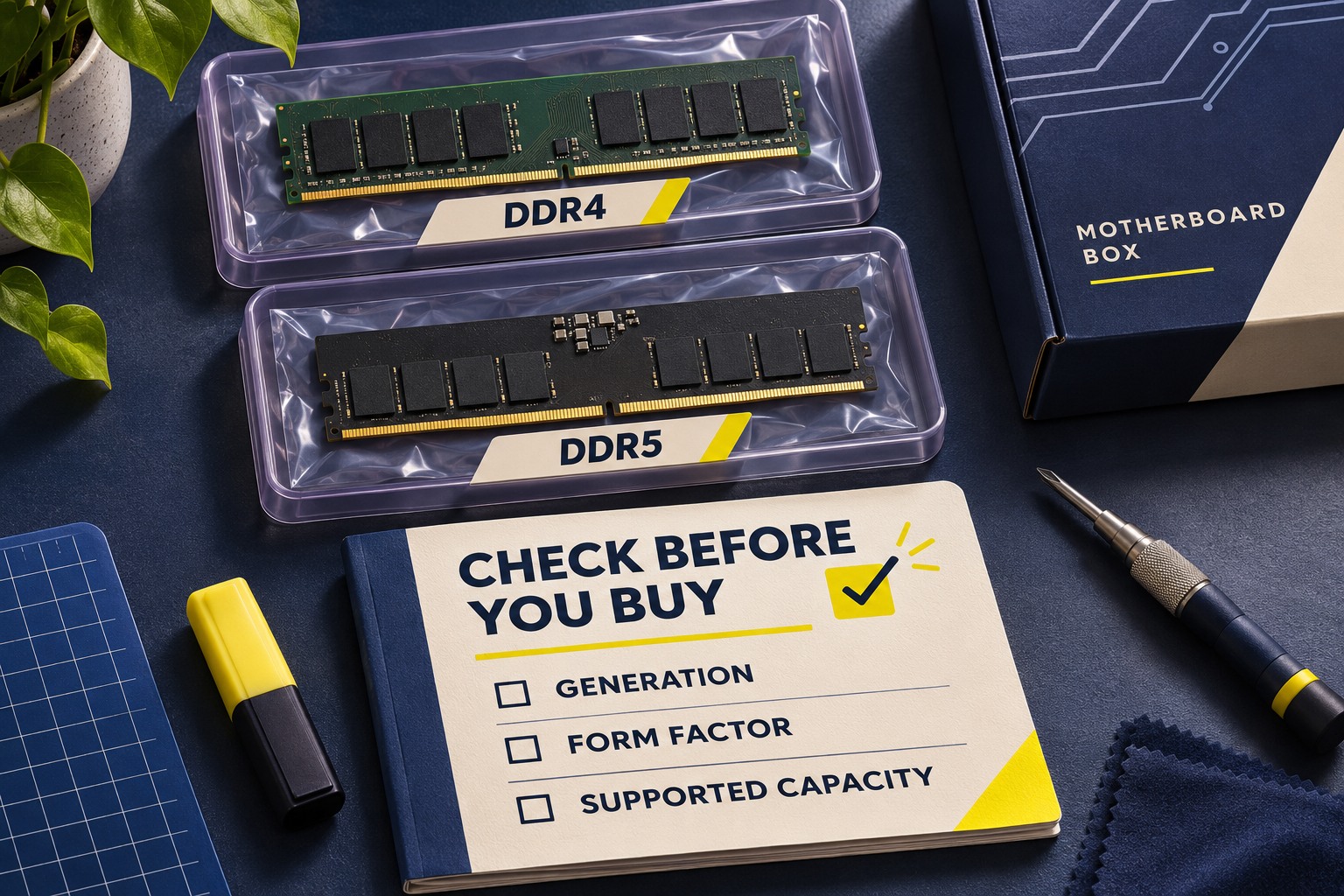
Confirm the supported DDR generation, module form factor, capacity limits, available slots, and manufacturer guidance for your exact machine. Some laptops also have soldered memory, which makes an ordinary module upgrade impossible.
Samsung's DDR5 explanation makes the basic generation issue clear: DDR5 does not fit and operate as a drop-in replacement for DDR4. The keying and platform support differ.
A bargain that requires an unplanned motherboard and CPU replacement has quietly become a different purchase.
3. Compare the complete purchase
Use a short shortlist of equivalent kits. Compare capacity, configuration, supported settings, delivery, taxes, and a credible warranty or return route. Check the manufacturer's guidance before mixing an existing kit with new modules.
You do not need a spreadsheet with seventeen colored tabs. Three comparable options are often more useful than thirty browser tabs containing products you cannot actually use.
Set a maximum spend based on the improvement you need. If an optional upgrade exceeds it, waiting is a deliberate choice. If work is being blocked and the complete upgrade is affordable, buying can also be a deliberate choice.
Neither decision requires predicting the global memory market from a chair next to your router.
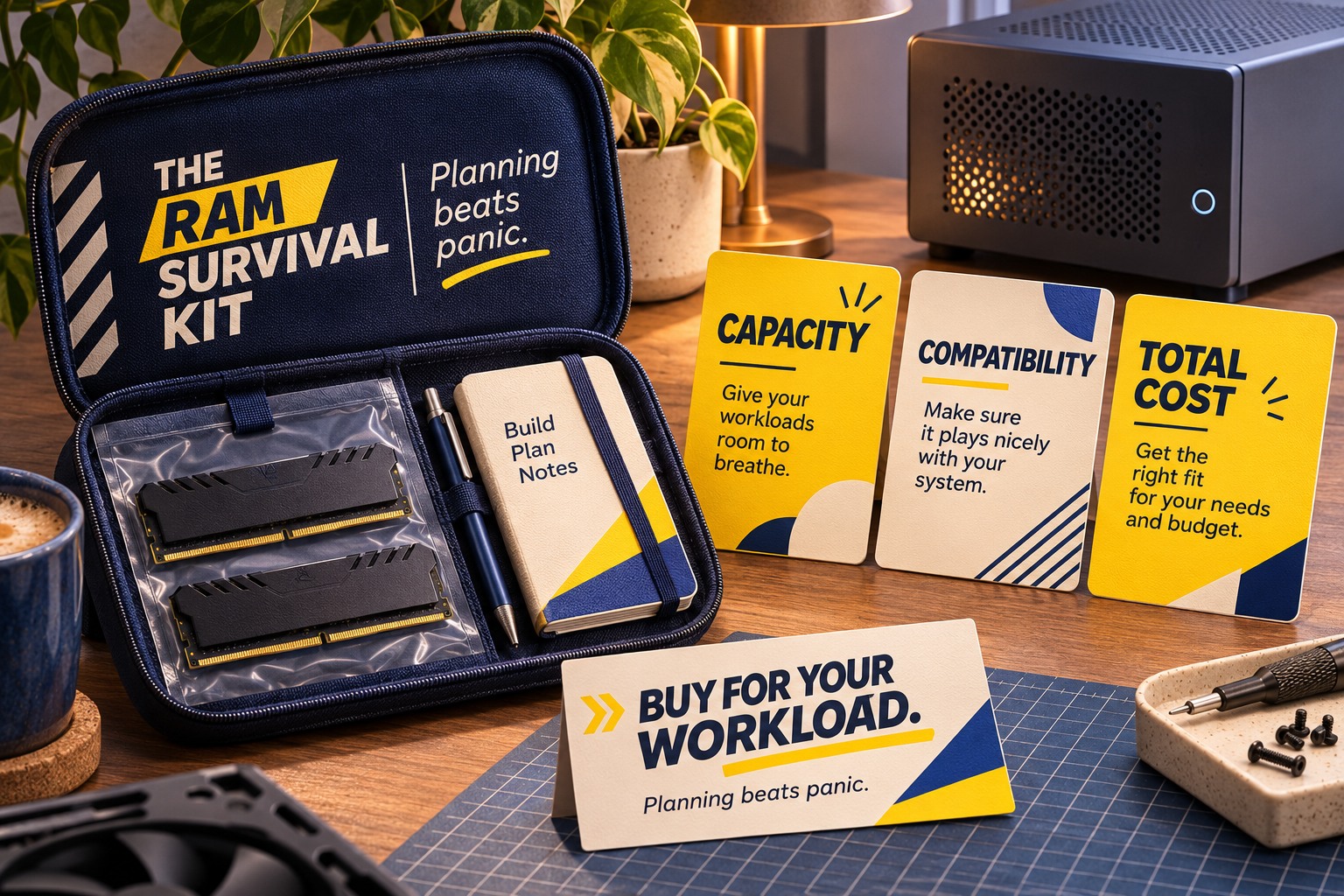
4. Buy for a workload, not a future argument
Avoid choosing extra capacity solely to win the imaginary conversation where someone asks how much RAM you have. Equally, do not undersize a machine that has a demonstrated need just to preserve an old budget assumption.
The useful target is enough dependable capacity for the work, with sensible room for growth. Application requirements and your actual projects are better starting points than a universal “everyone needs this much” rule.
A creative detour: save some budget for the work itself
For designers, it is easy to let the hardware discussion consume the entire project budget. A fast workstation is useful. So are a clear concept, good typography, and enough time to finish the layout.
Adobe's current Illustrator desktop requirements list 8GB of RAM as the minimum and 16GB as recommended. That is an application baseline, not a guarantee for every large document or combination of open apps. It gives you a reference to compare with your own workload.
If the computer already handles your typography work, you can still improve the result today. Explore Lettersiro's Grand Retro for expressive retro headlines, or browse the font collection for a typeface that suits the project. Choose the appropriate license for the intended use.
A distinctive headline can change the mood of a poster immediately. Another shopping-cart refresh mostly changes your mood.
Fonts are design tools, not a substitute for sufficient memory. The point is to fund the actual creative job instead of assuming every improvement has to arrive inside an antistatic bag.

Frequently asked questions
Was 2024 definitely the cheapest year to buy RAM?
No. Prices varied by month, generation, capacity, location, and retailer. The headline is a joke about a postponed upgrade, not evidence that every kit reached its lowest price in 2024. The late-2024 industry outlook itself still pointed to possible further declines.
Should I buy RAM immediately because prices might rise?
Buy when a compatible upgrade solves a real need at a total cost you can justify. A forecast does not make unused memory free. If the current computer is doing its job, you have more flexibility than someone whose work is blocked.
Is DDR4 always cheaper than DDR5?
Compare actual compatible products and the total platform cost. Reduced supply of an older generation can weaken the expected saving. A DDR5 kit also cannot simply replace DDR4 in a system designed only for DDR4.
Will more RAM make every computer faster?
It can help when memory capacity is the limitation. It does not automatically fix a CPU, graphics, storage, cooling, or software problem. Start by observing the machine during the task that feels slow.
Will RAM prices return to what I remember paying?
They may fall for some products or markets, but there is no guaranteed return date or universal historical price. Follow the exact compatible kit and your buying conditions rather than assuming a broad industry forecast is a retail promise.
Give 2024 you a break
The funniest part of the RAM regret meme is how ordinary the original decision was. You were trying to save a little money on a practical upgrade. You were not applying to run a semiconductor purchasing desk.
Hindsight makes the shopping cart look obvious. At the time, the future was still doing what it does best: refusing to send a useful calendar invitation.
Keep the joke. Keep the receipts. Make the next upgrade around a real bottleneck, a compatible part, and a budget that works.
We cannot reopen the 2024 checkout. We can stop turning the next purchase into another cautionary meme.