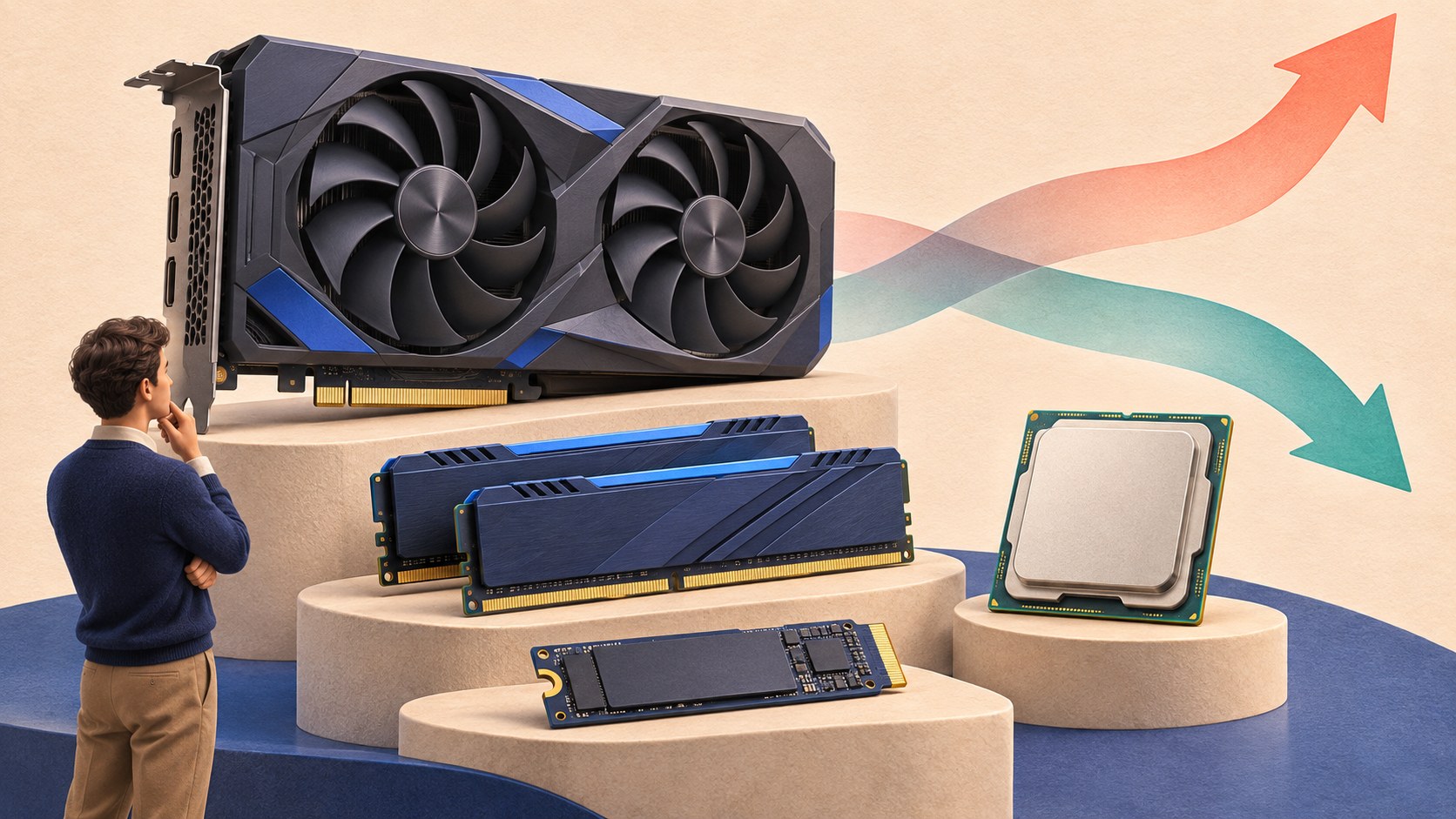
Will GPU and RAM prices keep rising, or will PC hardware finally become cheaper? The most useful answer in late 2026 is that different components face different pressures. Memory supply remains a concern, graphics-card prices depend on the exact model and local availability, and the outlook for SSDs can diverge from the outlook for desktop RAM.
For gamers, students, and creative professionals, that makes a single rule such as “buy everything now” or “wait until next year” unreliable. A better decision combines current evidence, the work your computer needs to handle, and the cost of postponing an upgrade.
Evidence reviewed: November 8, 2026. This article distinguishes published industry forecasts from our scenario analysis. All six images are original AI-generated editorial illustrations, not photographs of factories or charts of measured prices.
Will GPU and RAM prices drop in 2027?
A broad, immediate return to cheap PC components is uncertain. Recent supplier statements point to continued pressure on memory supply. However, that does not establish that every GPU, RAM kit, or SSD will rise in price every month.
In its third-quarter 2026 results, released October 29, Samsung described capacity constraints and strong server demand. The company also expected AI-driven memory demand in 2027 to exceed industry supply. That is a major supplier's outlook, rather than a guarantee about the price of a particular consumer product.
There is also a plausible route to lower prices in some categories: additional production, weaker consumer demand, improved availability, and competition between products. The timing and strength of those forces will differ across markets.
A current memory-market snapshot
The September 30, 2026 TrendForce outlook projected the following changes for the fourth quarter of 2026:
| Market measure | Published Q4 2026 forecast | What the figure describes |
|---|---|---|
| Conventional DRAM contract prices | Up 10–15% quarter over quarter | An industry contract-price forecast, not an exact retail RAM-kit increase |
| NAND flash contract prices | Up 15–20% quarter over quarter | A chip-market forecast, not an identical increase for every finished SSD |
These percentages apply to one quarter, not an annual rate that should be repeated indefinitely. They also do not mean your local store must change every shelf price by the same amount. Existing inventory, promotions, product specifications, currency movements, and distribution costs can produce a different retail result.
Why are hardware prices under pressure?
1. AI infrastructure competes for memory production
Large AI systems need memory and storage as well as processors. When suppliers prioritize products for those customers, the allocation of production capacity becomes important for the wider market.
In a September 2026 analysis of HBM supply, TrendForce described high-bandwidth memory and conventional DRAM competing for limited advanced-process and wafer capacity. HBM is specialized memory used in advanced computing systems; it is not simply a desktop RAM module moved into a server.
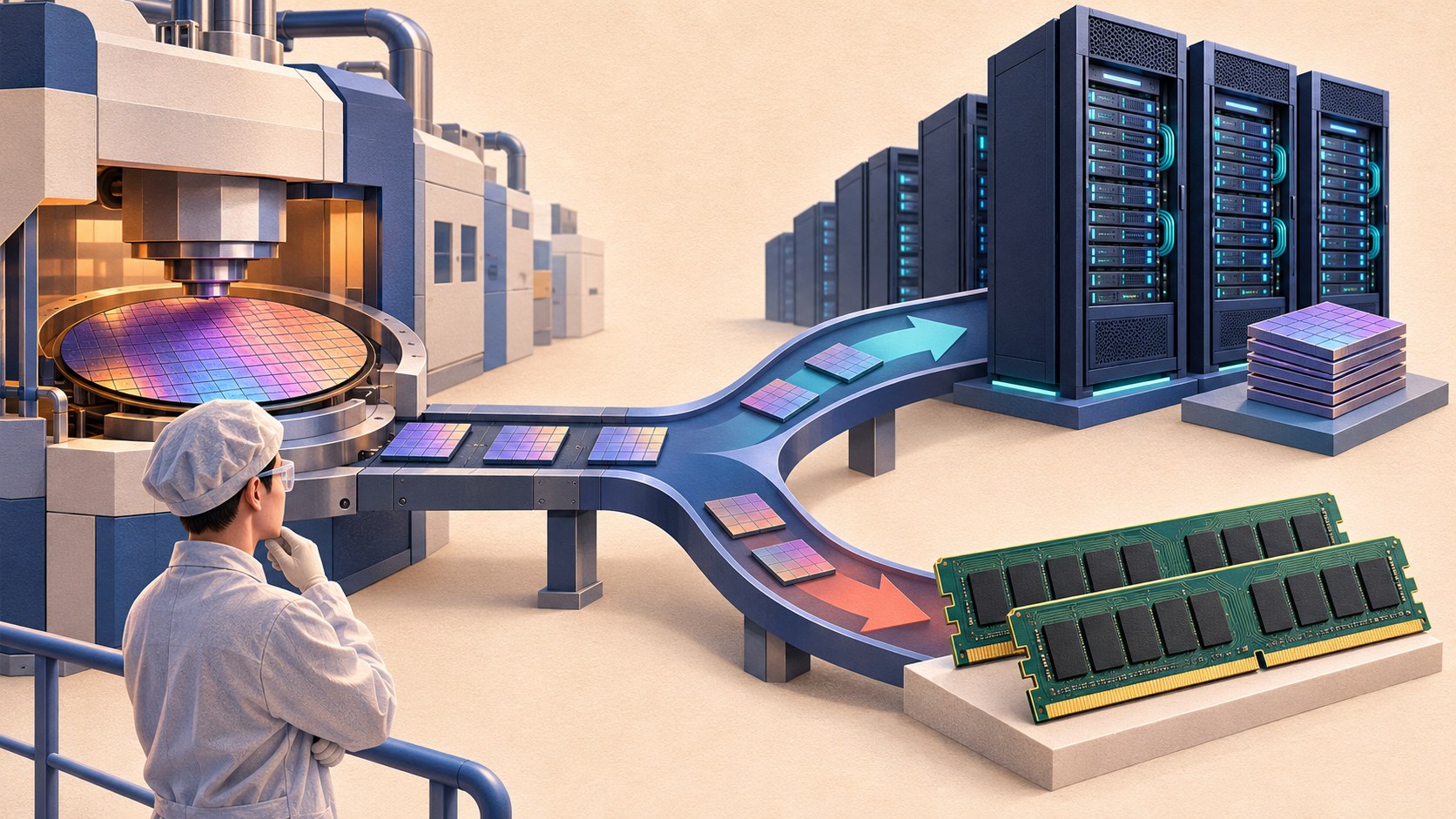
This distinction helps explain the connection without exaggerating it. A company buying an AI accelerator is not necessarily buying the same finished memory product as a home PC builder. The pressure can operate upstream through manufacturing priorities and capacity constraints.
2. New factories take time to contribute useful supply
An investment announcement is an early step. Construction, equipment installation, manufacturing qualification, and the gradual increase in usable output take additional time.
For example, Micron's Idaho project information says its first new Idaho fab is scheduled to begin DRAM output in 2027. Beginning production should not be confused with instantly supplying every customer at full volume.
Our inference is straightforward: new capacity can improve the longer-term balance, but the opening date of one facility is not a reliable date for a sudden retail price collapse. Demand may also grow while capacity is being added.
3. An older component is not automatically cheaper
Normally, buyers expect an older generation to become a bargain. That expectation can fail if production is reduced while enough customers still need replacements or upgrades.
TrendForce's April 2026 report on consumer DRAM linked price pressure to limited capacity and shifts in orders following earlier announcements that some legacy products would reach end of life. This is a reason to check the actual cost of an older platform rather than assume its age guarantees value.
A cheaper processor paired with expensive compatible memory can produce a less attractive complete build. Compare the total platform cost: CPU, motherboard, RAM, cooling, and any components that cannot be reused.
4. Retail prices have their own timing
A chip price, a manufacturer's recommended launch price, and a local shop's checkout price describe different stages of the market. Distributors and retailers may be selling stock purchased at different costs. A temporary discount can appear even during a broader shortage.
Currency changes, shipping, applicable import charges, warranty support, and seller margins also affect the final price. For readers in Indonesia or other import-dependent markets, a global dollar-price improvement may be partly offset by the exchange rate or local distribution conditions. This is a general pricing mechanism, not a forecast of the rupiah or a claim about a specific tax change.
GPU prices: why graphics cards need a separate forecast
Graphics cards, sometimes called VGA cards, combine a processor, graphics memory, a circuit board, cooling, and other components. Availability can therefore depend on more than the supply of one chip.
The memory type also matters. NVIDIA's GeForce RTX 50 series specifications list GDDR memory configurations. These consumer cards should not be treated as interchangeable with every HBM-based AI accelerator.
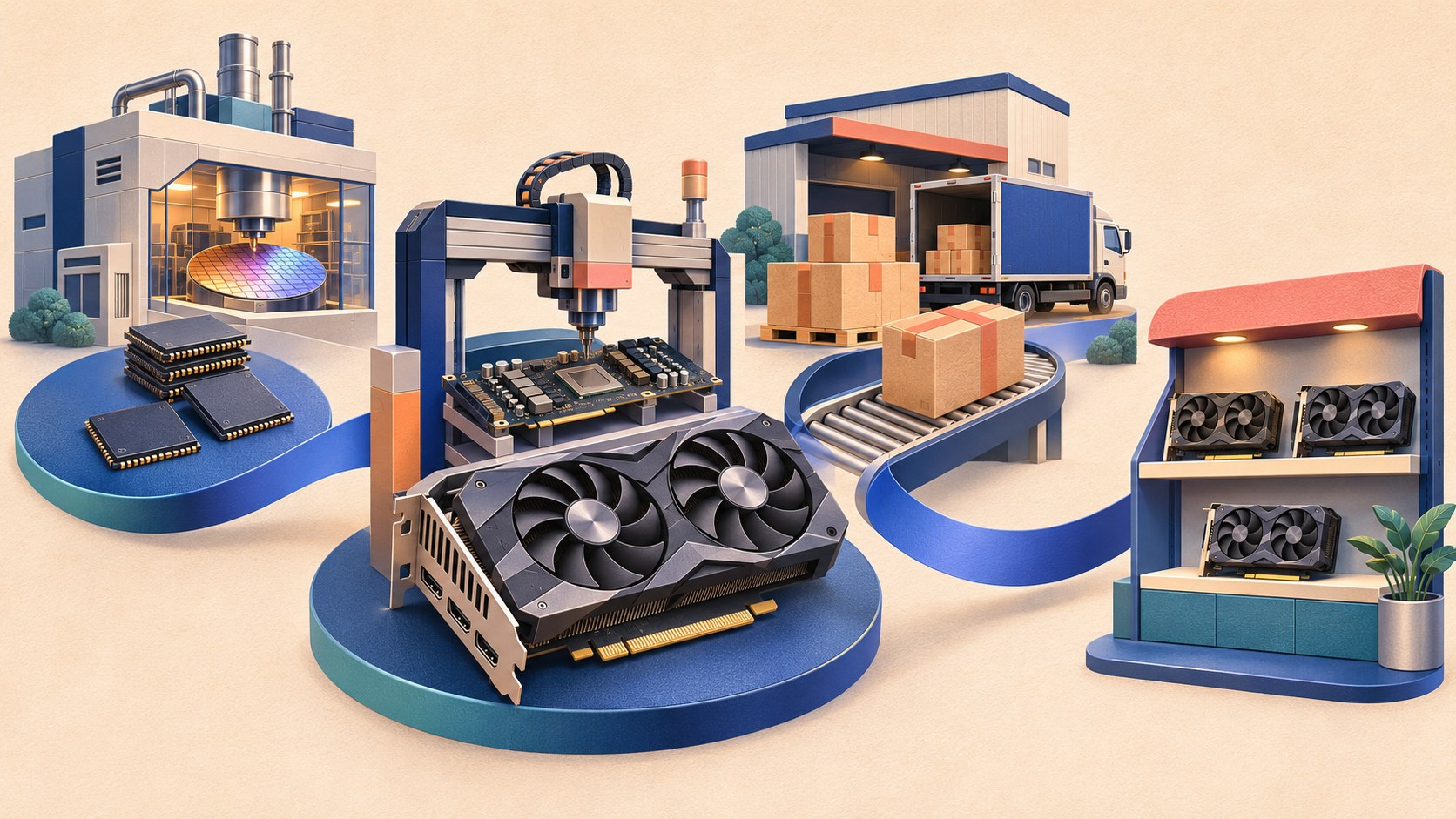
A high-demand GPU with substantial memory may remain expensive while a less sought-after model receives a promotion. A previous-generation card might offer good value, or it might remain overpriced because little new stock is available. Neither outcome can be inferred from the launch date alone.
For that reason, we do not assign a single percentage forecast to all consumer GPUs. A useful comparison tracks the exact model, memory capacity, warranty, and delivered price over time. Comparing a premium custom model today with a basic model's launch price can create a misleading impression of the market.
RAM, SSDs, CPUs, and motherboards can move differently
Treating every component as part of one identical shortage makes an upgrade decision harder. The important distinctions are:
- System RAM: desktop and laptop memory belongs to the DRAM market. Capacity, generation, module format, and platform compatibility affect which products you can use.
- SSDs: these depend primarily on NAND flash for storage, along with controllers, firmware, and sometimes separate DRAM. A RAM forecast cannot simply be copied onto an SSD.
- CPUs: compare the price and useful performance of the complete platform. A processor discount can be outweighed by costly compatible memory or a motherboard replacement.
- Motherboards, power supplies, and cooling: evaluate these against their own availability, quality requirements, and compatibility. A memory shortage alone does not tell you their exact future price.

The distinction is particularly important for storage. In its July 2026 outlook for 2027, TrendForce expected DRAM to remain constrained while NAND supply conditions could loosen in the second half of 2027. It also noted that stronger AI-related storage demand could absorb additional output.
That provides a conditional case for SSD price relief, rather than a promise that SSDs will be cheap by a particular month. Samsung's more recent emphasis on strong AI storage demand is another reason to keep checking whether supply is actually catching up. The two observations help frame uncertainty; they do not establish one fixed outcome.
Three hardware-price scenarios to watch
The following are our analytical scenarios, not additional industry forecasts or numerical probabilities.
Scenario 1: shortages persist
If demand keeps growing faster than usable supply, memory costs can remain elevated. Buyers may respond by choosing lower capacities, extending replacement cycles, or keeping older systems working longer. GPU pricing would still depend on the availability and demand for individual models.
Scenario 2: supply improves gradually
If production ramps successfully and demand growth becomes easier to serve, prices may stabilize before they fall meaningfully. More products could become available near their normal competitive price without returning to an earlier historical low.
Scenario 3: weaker demand creates more discounts
If consumers postpone purchases and sellers accumulate inventory, some categories could see stronger discounting. That could coexist with persistent shortages in particular memory products or high-demand graphics cards. A broad market headline would still need to be checked against the component you want.
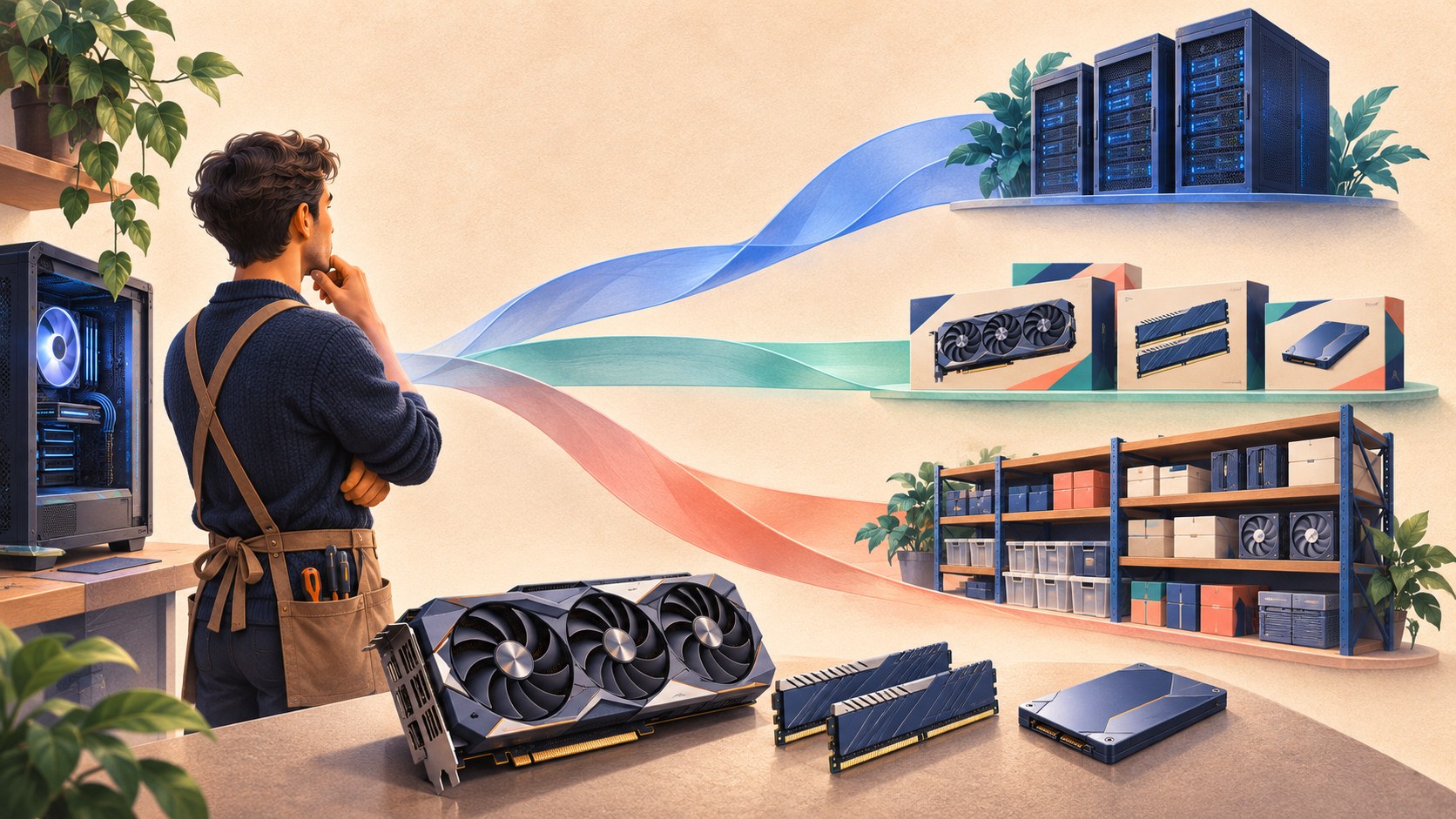
The most useful signals are practical: sustained stock across several reputable sellers, improving delivered prices for the same product, updated supplier guidance, and evidence that new production is reaching customers. A brief sale at one shop is a weaker signal than a lasting improvement across the market.
What higher hardware prices mean for everyday work
For students and gamers, higher upgrade costs can reduce the performance available within a fixed budget. For freelancers and small studios, they can delay a workstation replacement or leave less money for backup storage, software, training, and other business needs.
The effect also depends on the workload. Editing a large video project, rendering a complex 3D scene, and arranging a typographic logo have different bottlenecks. Buying a faster GPU will not necessarily resolve a shortage of system memory or a slow storage workflow.
There is a cost to waiting as well. If a failing computer repeatedly interrupts paid work, the value of a reliable replacement may matter more than a possible future discount. If your current system handles your projects well, you have more freedom to compare offers and wait for a suitable purchase.
A practical example for Lettersiro readers
For branding and typography projects, budget for the whole creative process. Check whether your current computer can handle your actual layout files before replacing an entire workstation. Adobe's current Illustrator requirements separate RAM, storage, and GPU requirements; they are a starting point for compatibility, while real project complexity determines the experience you need.

You can use that same project-first approach when choosing type. Explore the Lettersiro font collection, compare how a typeface fits the brand's character, and test readability at the sizes the project will use. A carefully chosen font and well-resolved spacing can improve the finished design without requiring the most expensive graphics card on the shelf.
Keep a separate allowance for the font license appropriate to your use. Desktop artwork, website embedding, and other uses can have different terms. This keeps hardware spending connected to the wider goal: delivering useful, distinctive work within a sustainable project budget.
Should you upgrade now or wait?
Use a short decision process instead of trying to predict the exact bottom of the market:
- Identify the problem. Is the system failing, running out of memory, waiting on storage, or struggling with a specific graphics workload?
- Check compatibility. Confirm the motherboard's supported memory, available storage slots, power supply, case clearance, and the requirements of your software.
- Price the complete solution. Include any required platform changes, delivery, and warranty coverage. Compare equivalent configurations.
- Track a small shortlist. Record the same products at several reputable sellers over time, rather than chasing every market headline.
- Set a decision threshold. Decide what reliable performance is worth for the work you need to complete. A necessary, affordable upgrade can make sense even if prices later decline.
- Keep flexibility where possible. Reusing compatible parts or making one targeted improvement can preserve budget, provided it genuinely addresses the bottleneck.
Avoid purchasing unnecessary components solely because a shortage story creates urgency. Likewise, avoid assuming that waiting always saves money. Both decisions should be tested against the actual system and the work it supports.
Frequently asked questions about GPU and RAM prices
Will RAM prices keep rising forever?
No forecast can establish that. Current supply pressure can last, but capacity, demand, technology, and purchasing behavior all change. A persistent shortage is different from an unlimited price increase.
Will graphics cards become cheaper in 2027?
Some models could, particularly if availability improves or competition and inventory create discounts. There is not enough evidence here to promise a price reduction for every GPU or a specific month for a market-wide decline.
Could SSD prices fall while RAM remains expensive?
Yes, that is possible because NAND storage and DRAM memory have different supply-demand conditions. Published industry analysis has described that potential divergence, although strong AI storage demand could reduce the extent of any relief.
Is an older DDR4 computer always the cheapest option?
No. Check the complete price and compatibility of the system. Reduced production of older components can weaken the expected savings, while the cost of a newer platform also needs to include its motherboard and memory.
Do graphic designers need a high-end GPU for font work?
The answer depends on the applications, effects, document size, and other tasks involved. Begin with the software requirements and your actual project performance. Typography and ordinary layout work should be assessed separately from demanding 3D rendering or local AI workloads.
Plan around the work you need to do
The outlook for GPU and RAM prices remains uneven. Memory supply is a reason for caution about assuming an immediate broad price drop, while additional capacity, changing demand, and product competition leave room for relief in particular categories.
Choose an upgrade that solves a real limitation, and treat every forecast as something to review as new evidence arrives. For creative professionals, keeping enough budget for dependable tools, suitable typefaces, and the time to develop a strong idea can matter as much as the next hardware specification.