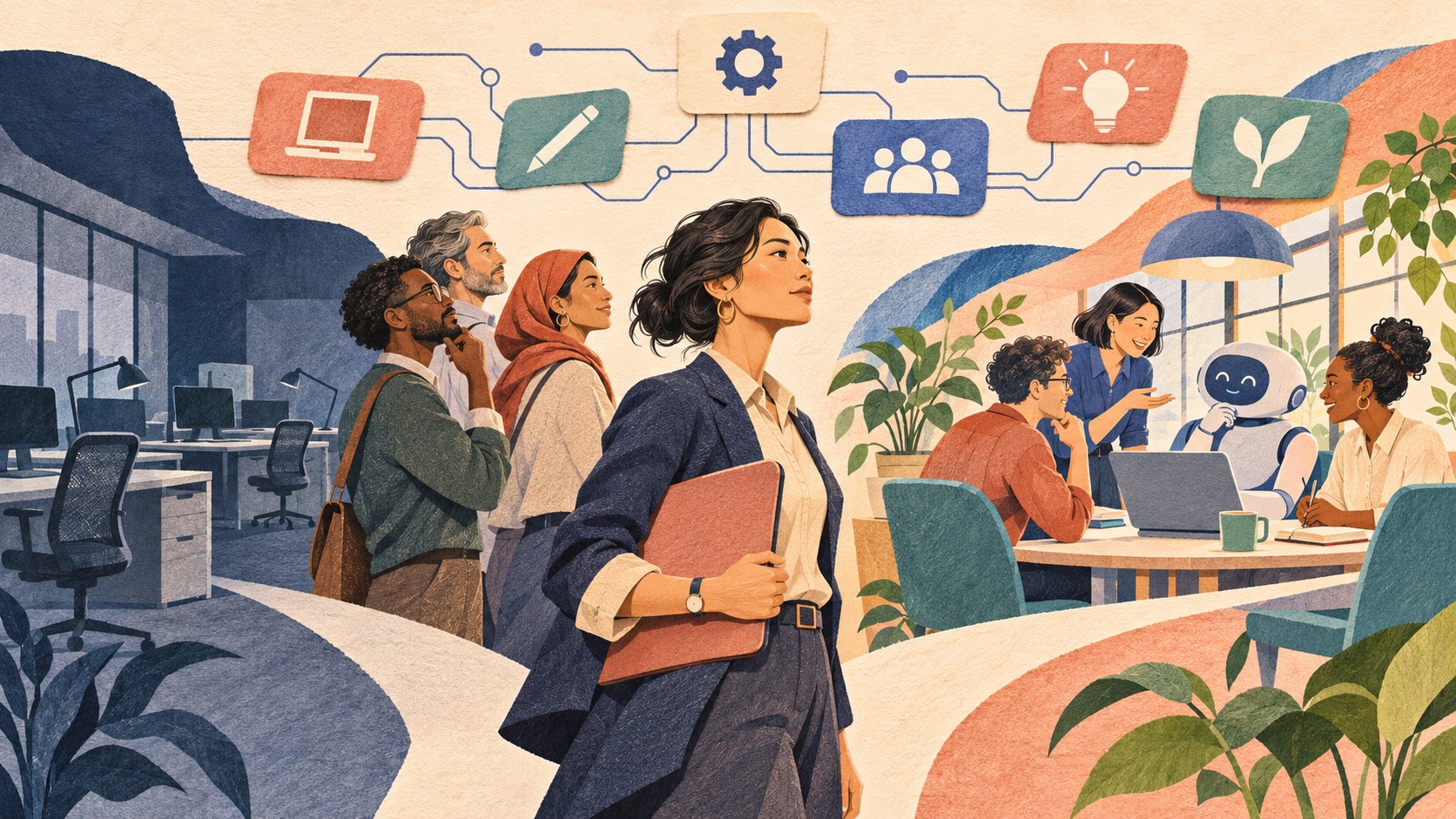
AI layoffs are no longer just a prediction about the future of work. Some employers now link job cuts to artificial intelligence, while others are slowing recruitment, reducing outsourced work, or redesigning teams around automated tasks. For employees, the effect can be a lost position, a smaller team, or a career ladder with fewer starting points.
However, a company mentioning AI does not prove that a machine replaced every person who left. Understanding the impact means separating announced layoffs, changing hiring patterns, and estimates of what technology could do. This guide examines the evidence and the kinds of work facing pressure, without treating every occupation as equally vulnerable.
Evidence reviewed: November 8, 2026. All six illustrations are original AI-generated editorial concepts, not photographs of actual employees, company offices, or layoffs.
Are AI layoffs actually happening?
Yes, there are company announcements explicitly connecting workforce reductions with AI-enabled changes. One clear example is Block, the financial technology company behind Square and Cash App. In its Q4 2025 shareholder letter, filed in 2026, the company said that more than 4,000 people would leave or enter consultation as it substantially reduced its workforce.
CEO Jack Dorsey linked the decision to management's belief that intelligence tools would allow a smaller organization to accomplish more. That is a documented explanation from the employer. It is not an independent measurement showing that AI alone made every affected position unnecessary.
Amazon offers a different kind of evidence. In a 2025 message to employees, CEO Andy Jassy said wider use of generative AI would change staffing needs and was expected to reduce the company's corporate workforce over the following years. That statement describes an expectation and operating strategy; it is not a count of employees demonstrably replaced by AI.
These distinctions matter. A confirmed restructuring announcement, a forecast about future staffing, and an observed fall in hiring answer different questions. Combining them into one dramatic global layoff total can mislead readers.
AI exposure does not mean a job has disappeared
The International Labour Organization's explanation of its 2025 occupational exposure research puts roughly one-quarter of global employment in occupations with some exposure to generative AI. Exposure means that technology could perform parts of the work. It does not mean one-quarter of workers have been dismissed, or will inevitably lose their jobs.
Think of the process in three stages:
- Capability: a tool can produce a draft, classify a document, or answer a routine question.
- Adoption: an organization integrates that capability into a reliable working process.
- Employment change: managers alter recruitment, staffing, contracts, or job responsibilities.
The last stage is a business decision, not an automatic consequence of the first. Demand, service standards, implementation costs, and the amount of human review all influence the result.
A June 2026 ILO review of empirical research found that large-scale displacement remained limited, even as work organization and opportunities for younger workers were changing. That wider finding can coexist with serious losses at particular companies or in particular roles.
Which kinds of work face pressure from AI?
The useful starting point is the task, rather than the job title. Repeated digital work with clear inputs and easily checked outputs is a natural target for automation. The following examples describe possible workflow changes, not a ranking of measured layoff rates.
| Work area | Tasks that may be automated or accelerated | Human responsibilities that remain important |
|---|---|---|
| Customer support | Routine answers, ticket summaries, initial routing | Difficult disputes, empathy, escalation, accountable decisions |
| Administration, HR, and bookkeeping | Form processing, scheduling, standard document drafts | Exceptions, confidential situations, reconciliation, verification |
| Marketing, design, and translation | First drafts, visual variations, straightforward localization | Strategy, originality, cultural nuance, brand judgment |
| Software development | Boilerplate code, documentation, draft tests | Architecture, debugging, security review, understanding requirements |
| Finance and business research | Summaries, data extraction, recurring report drafts | Checking evidence, interpreting assumptions, explaining consequences |
1. Customer support and service operations
An AI assistant can handle predictable questions or help an agent draft a response. If a company can serve the same demand with fewer paid hours, it may reduce recruitment or staffing. Another company may use the extra capacity to shorten waiting times or improve coverage. The technology does not determine which choice management makes.

There is evidence for assistance as well as substitution. The 2023 NBER working paper Generative AI at Work studied a tool used by customer support agents and reported an average productivity improvement of 14%, measured through issues resolved per hour. That result concerns performance in a particular setting; it is not a finding that 14% of support workers should be removed.
For an employer, the important question is whether the complete service still works: can customers reach a person, are errors corrected, and do difficult cases receive enough time?
2. Administrative work, HR support, and bookkeeping
The ILO identifies clerical occupations as especially exposed, including data entry and bookkeeping support. A workflow built around copying information between standard forms is different from one requiring negotiation, sensitive conversations, or investigation of unusual records.
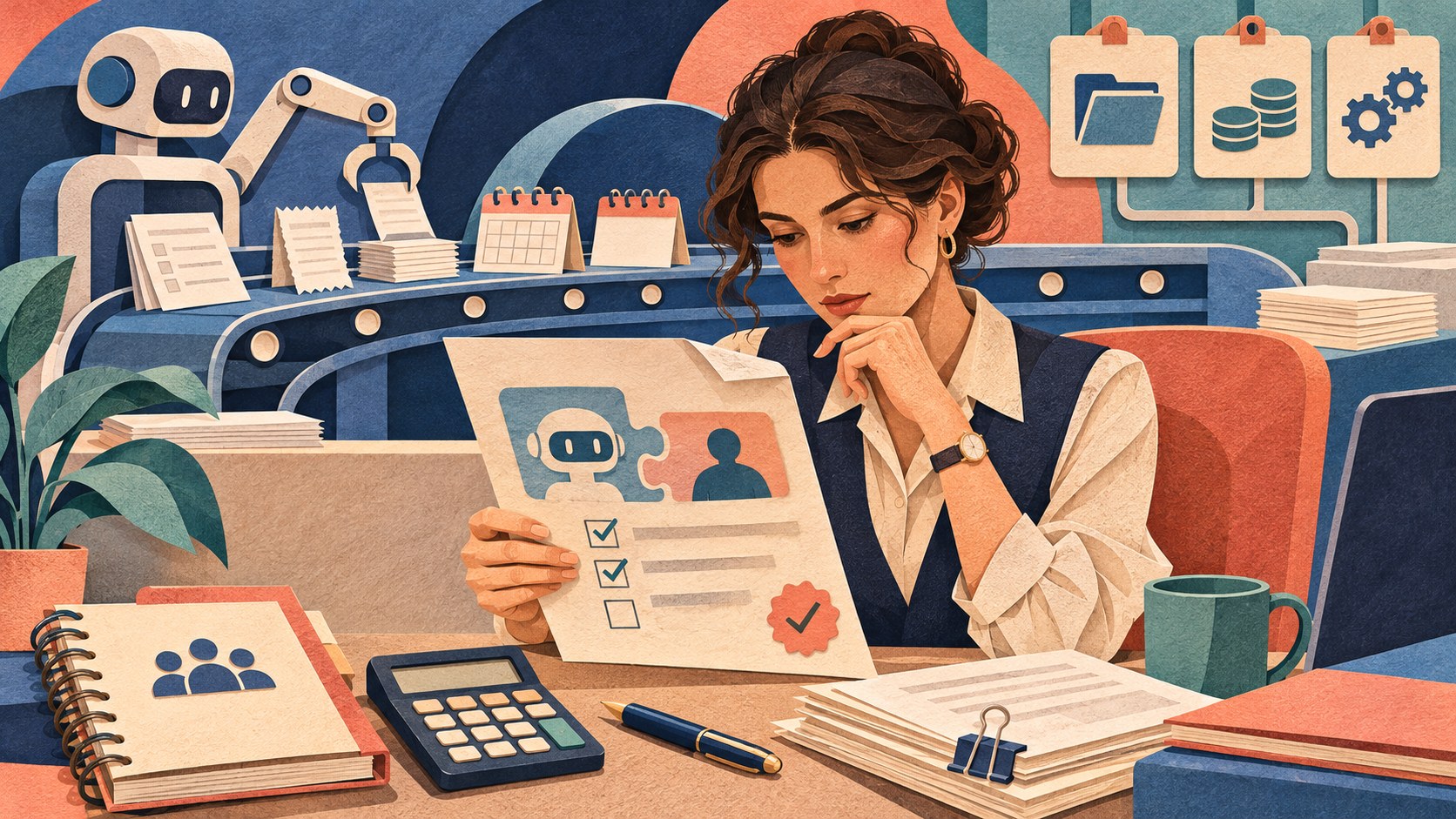
Consider a fictional office that uses AI to prepare routine onboarding documents. The relevant change is not simply whether the first draft arrives faster. Someone still needs to confirm that the details are accurate, resolve missing information, and decide how unusual cases should be handled.
This is where a job can be redesigned rather than eliminated. It can also be where one employee inherits too many exceptions after colleagues leave. Counting documents processed without checking accuracy and workload gives an incomplete picture of the outcome.
3. Marketing, graphic design, content, and translation
Creative work can face pressure when clients treat drafts and variations as interchangeable output. A tool that produces many image options or short copy drafts can change budgets for routine production, especially where the brief rewards quantity more than distinctive thinking.

The World Economic Forum's Future of Jobs Report 2025 includes graphic designers among roles employers expect to decline. This is an employer-based projection, not a count of design jobs already lost. The same report also anticipates growth in other occupations, including software and applications developers.
For designers and writers, a useful response is to make the thinking behind the work visible: how the brief was interpreted, why a concept was selected, and how the result was refined. Translation likewise needs a distinction between a serviceable first pass and communication that handles tone, context, and cultural meaning.
For more on the judgment involved in creative AI use, read our guide to the ethics of AI design.
4. Software development and entry-level technical work
Code generation can shorten routine implementation, but a working product needs more than plausible code. Requirements must be clarified, failures investigated, and security and maintenance considered. Producing a draft quickly does not establish that the system behaves correctly.

The entry-level hiring question deserves special attention. The Stanford Digital Economy Lab's August 2026 revision of Canaries in the Coal Mine? examined U.S. payroll data through June 2026. It reported that employment among workers aged 22–25 in AI-exposed occupations was 19% below a comparison path based on less-exposed peers.
The researchers found that the divergence operated mainly through reduced hiring, rather than more separations. They described the findings as early descriptive indicators, not causal estimates, and did not find widespread economy-wide displacement. The 19% figure therefore does not mean AI fired 19% of young workers.
For a junior applicant, fewer openings can still be a serious problem. Employers need to consider how people will develop experience if the tasks traditionally assigned to beginners are automated without a replacement training route.
5. Financial analysis, research, and reporting
AI can assist with extracting information, comparing documents, and drafting recurring reports. This may change the amount of routine preparation assigned to analysts, but fluent summaries do not establish that the evidence is complete or the assumptions are sound.
An analyst's contribution includes asking whether two figures are comparable, spotting missing context, and explaining uncertainty. Teams should test the entire research process before assuming that faster preparation supports a proportional reduction in staffing. The ILO's occupational analysis also identifies increasing exposure in professional roles such as financial analysis.
Why a headline cannot explain every job cut
Before concluding that AI caused a particular layoff, ask what the evidence actually says:
- Did the employer explicitly connect the reduction to AI? A new AI product and a simultaneous restructuring are not, by themselves, proof of direct replacement.
- What changed: employees, vacancies, contractors, or tasks? These affect people differently and should not be counted as the same event.
- What other business conditions were involved? Investigate demand, organizational changes, and cost targets rather than assuming one explanation fits every company.
- Was the claimed productivity gain measured across the full workflow? Drafting time alone leaves out review, corrections, customer impact, and ongoing maintenance.
This approach takes job losses seriously while avoiding a misleading picture of a workforce replaced overnight. It also keeps attention on choices employers can influence.
How workers can respond without relying on empty promises
Learning AI tools can be useful, but it cannot guarantee job security. Business closures, reorganizations, and staffing decisions can affect capable people. A more practical response is to build a clearer account of the value you provide.

- Map your tasks. Separate repeatable preparation from the decisions, relationships, and exceptions that require your expertise.
- Learn an approved workflow. Practice with public or fictional material and follow your organization's rules for confidential information.
- Show your review process. Explain how you check an AI-assisted result, identify errors, and decide what must be changed.
- Document outcomes honestly. Use verified examples of useful work instead of invented productivity percentages or a list of tools without context.
- Keep developing domain knowledge. Understanding the customer, subject, or operating environment helps you recognize when a convincing output is wrong.
- Maintain a realistic transition plan. Keep your portfolio and professional contacts current, and explore adjacent roles where your existing experience remains relevant.
What employers should do before cutting a team
A responsible assessment includes service quality, error rates, supervision, workload, and the loss of institutional knowledge. A reduction that looks efficient on a spreadsheet can leave a smaller group handling work that the automated system cannot resolve.
Employers should involve affected teams, provide time for training, and consider redeployment before treating dismissal as the default option. They should also communicate clearly about what is changing. Employees deserve a concrete explanation rather than a vague instruction to become more productive with AI.
Frequently asked questions about AI layoffs
Is AI already causing layoffs?
Some employers explicitly connect workforce reductions to AI-enabled operating changes. However, the strength of the evidence varies by announcement. A forecast, a hiring slowdown, and a completed dismissal are different things.
Which jobs are most affected by AI?
Routine digital tasks in support, clerical work, content production, and some technical workflows are important areas to examine. Exposure varies within occupations, so the actual task mix is more informative than a job title alone.
Will learning AI protect my job?
It may improve your options and help you adapt to changing workflows, but it offers no guarantee. Domain expertise, judgment, collaboration, and an employer's business decisions also shape the outcome.
Does greater productivity always mean fewer employees?
No. A business can use additional capacity to improve service, expand output, or develop new offerings. It can also choose to reduce staffing. The employment outcome depends on demand and organizational decisions as well as technical capability.
The human choices behind AI and job losses
AI is changing how work is organized, and some people are already bearing the cost through layoffs or fewer opportunities to enter a profession. The evidence supports taking that disruption seriously while resisting claims that every exposed job is destined to disappear.
The most useful question is what happens after a task becomes faster. Employers can invest in better work and new capabilities, or use the change mainly to reduce headcount. Workers need practical learning opportunities and clear information; they should not be asked to carry the entire transition alone.